
Grow To Eat vs Planter: which garden planner is right for you?
Grow To Eat vs Planter is a question of when you want the help. Planter is a cheap, visual tool for laying out a garden in February. Grow To Eat is built for the ten months afterwards, when the plan has to turn into actual food.
Planter is the cheaper of the two, and the more visual: a square-foot grid with 1,000+ illustrated plant tiles, drag-and-drop beds, companion planting, and a free tier that includes a whole garden. Grow To Eat carries more crops — 120+ against 80+ — with full growing guides for each, a weekly view of what needs doing, and succession planting so beds keep producing after the first harvest.
At a glance
What they share
- ✓Drag-and-drop garden bed planner
- ✓A planting calendar tuned to where you garden
- ✓Companion planting guidance
- ✓Add your own crops and varieties
- ✓A free tier that never expires
- ✓Native iPhone and Android apps
Where Grow To Eat differs
- ●120+ crops with full growing guides, against 80+ plants
- ●A weekly “what to do now” view, not just a plan you made in winter
- ●Guides that run from propagation through harvest to preservation
- ●Succession planting so beds keep producing after the first crop
- ●Berries, bushes and perennials included on the free tier
- ●Crop suggestions filtered by shade, pollinator value and difficulty
Grow To Eat vs Planter: feature comparison
| Feature | Planter | Grow To Eat |
|---|---|---|
| Once the season starts | ||
| Weekly “what to do now” view | – | ✓ |
| Task list for what's due | Partial | ✓ |
| Harvest tracking | – | ✓ |
| Succession planting for continuous harvest | – | ✓ |
| A–Z guides: propagation to preservation | Partial | ✓ |
| What you can grow | ||
| Crops in the library | 80+ plants | 120+ edible crops |
| Named varieties built in | 1,000+ | No — you add your own |
| Perennials, berries and bushes | Partial | ✓ |
| Crop filters (shade, pollinators, difficulty) | – | ✓ |
| Where and how you use it | ||
| Personalised planting dates | ✓ | Yes — from your location |
| Square-foot grid | ✓ | – |
| Gardens you can create | 1 free, unlimited on Premium | 1, with unlimited beds |
| Platforms | iOS, Android, Fire, web | iOS, Android |
| What it costs | ||
| What's behind the paywall | Unlimited gardens, notes, web app | Garden planner, succession planting, custom crops |
| Free tier | 1 garden, calendar, custom plants | Uncapped sowing plan + all guides |
| Yearly price | $24.99 | €44.99 |
| Lifetime purchase | $99.99 | — |
Prices and features checked August 2026. Planter pricing shown in USD, Grow To Eat in EUR. Sources: . Planter features and pricing taken from planter.garden, August 2026. Prices shown in the currency each app charges in.
A plan that keeps working after planting day
Free sowing plans and full A–Z growing guides. No credit card required.
The key differences explained
Planning the garden, or running it
Planter is very good at the first job. You lay out beds on a square-foot grid, drop in illustrated plant tiles, check companions, and end up with a plan of the plot. For an evening in February that is a good way to spend an hour.
Then the season starts. Planter Premium adds notes and events, so you can record things against the plan — but the app is built around the layout, and an independent test of its free tier put it plainly: it goes quiet once you are growing, and you become the notification system.
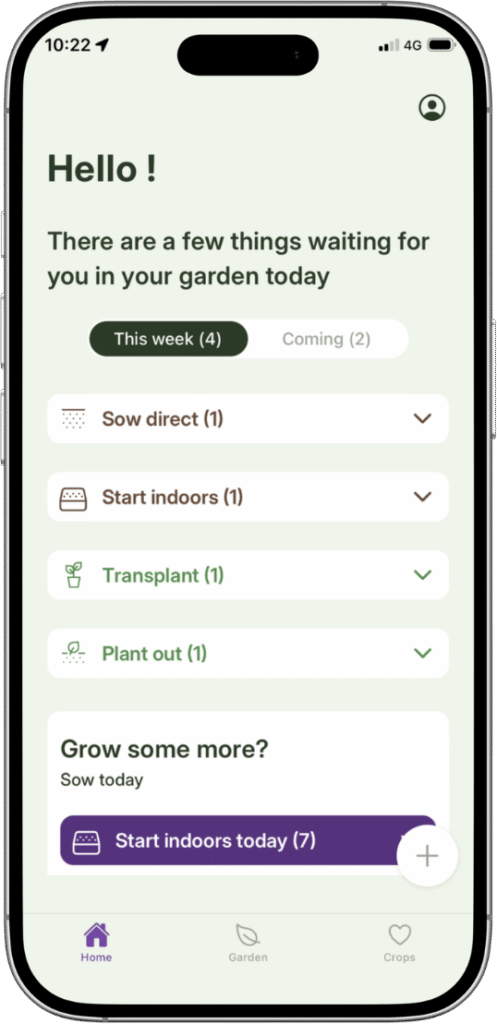
Grow To Eat is built around that second half. The home screen shows your planned sowings, the next steps due and what is ready to harvest, plus which crops are worth starting this week indoors and out. Making a plan and following one are different problems, and most garden apps only solve the first.
More crops, or more varieties
The two libraries are built to different ends. Planter has 80+ plants but 1,000+ named varieties, drawn as illustrated tiles you place on the grid — the library exists mainly to make the layout accurate.
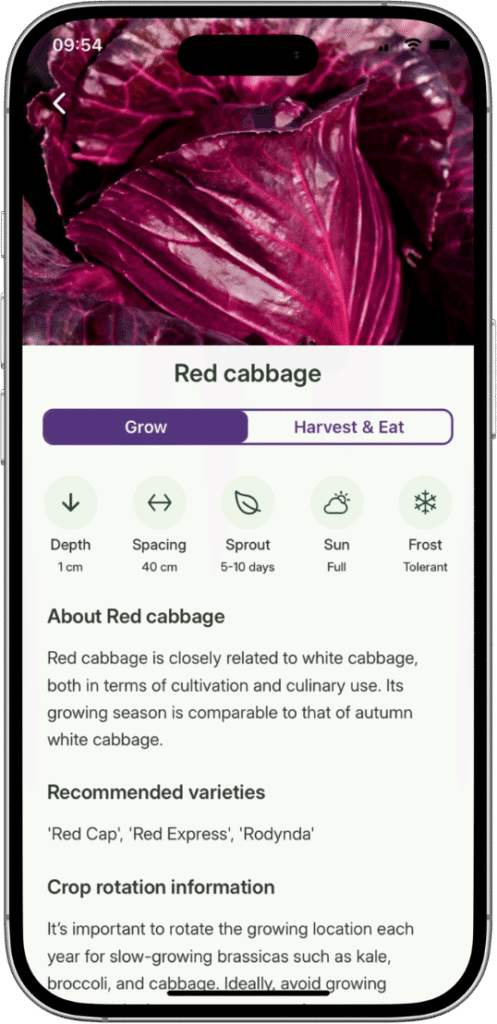
Grow To Eat has 120+ crops, half as many again, and behind each one sits a full growing guide: how to propagate it, when to pot on and plant out, how to harvest, and how to store or preserve what you pick. Named varieties are left out on purpose — you add the ones you actually sow — because most gardeners grow a handful they already trust.
If you want a specific heritage variety drawn on your plan, Planter has more of them. If you want to be told how to grow the thing once it is in the ground, there is more here.
What you get without paying — and what it costs after
Planter’s free tier is generous and includes the thing it does best: one complete garden on the square-foot grid, the planting calendar, custom plants and a seed box. Grow To Eat’s free tier does not include the garden planner at all — that is Premium — but it does include your sowing plan, the weekly view, every growing guide, the crop filters, and perennials, berries and bushes, none of it capped.
On price, Planter wins and it is not close: $24.99 a year, or $99.99 once and never again. Grow To Eat is €7.49 a month or €44.99 a year, with no lifetime option.
So the honest summary is that Planter costs less and looks better, and Grow To Eat does more once the growing starts. Which matters more depends on whether you already know how to grow the things you are planting.

Know what to do in the garden this week
Free to start on iPhone and Android. Upgrade any time.
Where Planter does it better
Planter does several things better than Grow To Eat, and two of them are the first things most people look at — price and how it looks:
- It costs less: $24.99 a year against €44.99, and a $99.99 lifetime purchase with no equivalent in Grow To Eat. If budget is the deciding factor, this is a short conversation.
- A free garden layout: Planter's free tier includes a complete garden on the square-foot grid. Grow To Eat's bed planner is Premium only, so on the free tier Planter gives you something we do not.
- Custom plants on the free tier: Adding your own plants is free in Planter. In Grow To Eat it is a Premium feature.
- A square-foot grid with illustrated tiles: Planter lays gardens out on a square-foot grid using 1,000+ illustrated plant tiles. Grow To Eat draws plain rectangular beds at any size, with no grid subdivision.
- More named varieties: 1,000+ against none built in. If you plan by variety rather than by crop, that matters.
- Web and Amazon Fire: Planter runs in a browser on Premium and on Amazon Fire tablets. Grow To Eat is iPhone and Android only.
If what you want is an inexpensive, visual way to lay out a vegetable patch — and you already know how to grow what you are putting in it — Planter is a good app and the cheaper answer.
Choose Planter if…
- You want a square-foot grid with illustrated plant tiles
- You want to spend as little as possible, or buy once for life
- You want a free garden layout without paying anything
- You plan by named variety and want a thousand to choose from
- You want it on a desktop browser or an Amazon Fire tablet
Choose Grow To Eat if…
- You want a weekly view of the season, not just a layout to refer back to
- You want a weekly view of what needs sowing, doing and harvesting
- You want full growing guides for each crop, not just a tile on a grid
- You want succession planting so beds keep producing
- You are still learning how to grow some of what you are planting
Grow To Eat vs Planter: the bottom line
Planter is the cheaper of the two, and the stronger layout tool. A square-foot grid, 1,000+ illustrated varieties, a free garden layout and a $99.99 lifetime option — for laying out a plot it is both cheaper and more visual than Grow To Eat.
Grow To Eat is the better companion once the plan exists. Half as many crops again, each with a full growing guide, a weekly view of what needs doing, harvest tracking and succession planting.
One of them helps you decide what goes where. The other helps you get it out of the ground and onto a plate. If you already know how to grow, Planter may be all you need.
Frequently asked questions
Is Planter free?
Which is cheaper, Grow To Eat or Planter?
Does Planter tell you what to do during the season?
Which has more plants?
Does Grow To Eat have a free garden planner?
What are the best Planter alternatives?
Grow To Eat stays useful all season, not just in planning week.
Free sowing plans and growing guides. No credit card required.
Head-to-head comparisons
Last updated: August 2026