
Grow To Eat vs Seedtime: which garden planner is right for you?
Grow To Eat gives you an uncapped sowing plan, with Premium at €44.99 a year and nothing metered. Seedtime is one of the closest alternatives — it also builds planting dates from your location and has apps for iPhone and Android, plus a browser planner and a broader set of tools. Seedtime Basic costs $84 a year and includes 1,200 AI planning credits a year; Unlimited costs $168 a year and removes the credit limit.
Grow To Eat does less on purpose: sowing plans from your location, a weekly view of what to do next, 120+ edible crops each with a full growing guide, and a garden planner with unlimited beds — €44.99 a year, nothing metered, and a free tier that never expires.
Where Seedtime goes further is breadth: 9,705+ built-in varieties, a photo journal, harvest records with weights and analytics, a winter-gardening algorithm for row covers, inventory tracking, and a classroom and community attached. That breadth costs $84 a year on Basic and $168 on Unlimited — and on Free and Basic the seeding-date suggestions are metered, 10 a month and 100 a month, unlimited only on the $168 plan.
At a glance
What they share
- ✓Sowing and harvest dates built from your location
- ✓Succession planting to keep beds producing
- ✓Visual garden bed planner (paid in both)
- ✓Native iPhone and Android apps
- ✓A free tier you can keep using indefinitely
- ✓Step-by-step growing guidance for each crop
- ✓Later dates shift when you sow late — both work from the actual sowing date
Where Grow To Eat differs
- ●€44.99 a year against $84 — roughly half the price
- ●Nothing metered: sowing dates and guides are never credit-limited
- ●Berries, bushes and perennials on the free tier, not behind a paid plan
- ●Unlimited beds inside your garden, included with Premium
- ●Built only for edible crops — no ornamentals to wade through
- ●Crops, not thousands of varieties — add the ones you actually sow (Premium)
- ●Automatic dates across the northern hemisphere, no frost dates to look up
- ●One job: growing food, not inventory, analytics or a store
Grow To Eat vs Seedtime: feature comparison
| Feature | Seedtime | Grow To Eat |
|---|---|---|
| Once the season starts | ||
| Seeding-date suggestions | Credit-metered: 10/mo free, 1,200/year Basic | Unmetered |
| Weekly “what to do now” view | ✓ | ✓ |
| Harvest tracking | Weight, value and analytics | Mark a crop harvested |
| Winter gardening / row cover estimates | ✓ | – |
| Garden journal with photos | ✓ | Notes only — no journal |
| What you can grow | ||
| Crops in the library | Vegetables, herbs, perennials | 120+ edible crops |
| Named varieties built in | 9,705+ | No — by design, you add your own |
| Perennials, berries and bushes | ✓ | ✓ |
| Crop filters (shade, pollinators, difficulty) | – | ✓ |
| A–Z guides: propagation to preservation | Partial | ✓ |
| Where and how you use it | ||
| Automatic dates without manual setup | US locations | Northern hemisphere |
| Where it works | Global, manual frost dates outside US | Northern hemisphere |
| Gardens you can create | 1 on Basic, unlimited on Unlimited | 1, with unlimited beds |
| What it costs | ||
| What's behind the paywall | Layouts, custom crops, perennials, companion planting | Garden planner, succession planting, custom crops |
| Free tier | 1 calendar, 10 credits/mo | Uncapped sowing plan + all guides |
| Yearly price | $84 Basic / $168 Unlimited | €44.99 |
Prices and features checked August 2026. Seedtime pricing shown in USD, Grow To Eat in EUR. Prices shown in the currency each app charges in.
A full sowing plan, with nothing metered
Free sowing plans and full A–Z growing guides. No credit card required.
The key differences explained
What a year actually costs
Seedtime has two paid tiers. Basic is $7 a month billed annually — $84 a year — and gives you one garden layout, custom crops and companion planting. Unlimited is $9.10 a month annually, $168 a year, and adds multiple calendars and layouts, inventory and analytics. Month-to-month is $10 and $13. There is a 7-day trial and a 30-day money-back guarantee.
Grow To Eat Premium is €7.49 a month or €44.99 a year — roughly half the price of Seedtime Basic, and around a quarter of Unlimited. For that you get the garden planner with unlimited beds, the bed-by-bed overview and succession planting.
Seedtime is the larger product and some of that difference is features you may may well want. But if what you need is a sowing plan and a garden layout, you are paying about twice as much for them.
Credits, and what happens when they run out
Seedtime meters its seeding-date suggestions with monthly credits: 10 a month on the free tier, 1,200 per year in Basic, unlimited only on the $168 plan. To be fair to them, this caps one specific feature — planting schedules, tasks and journal entries are unlimited even on Free, and the free tier is more generous than most.
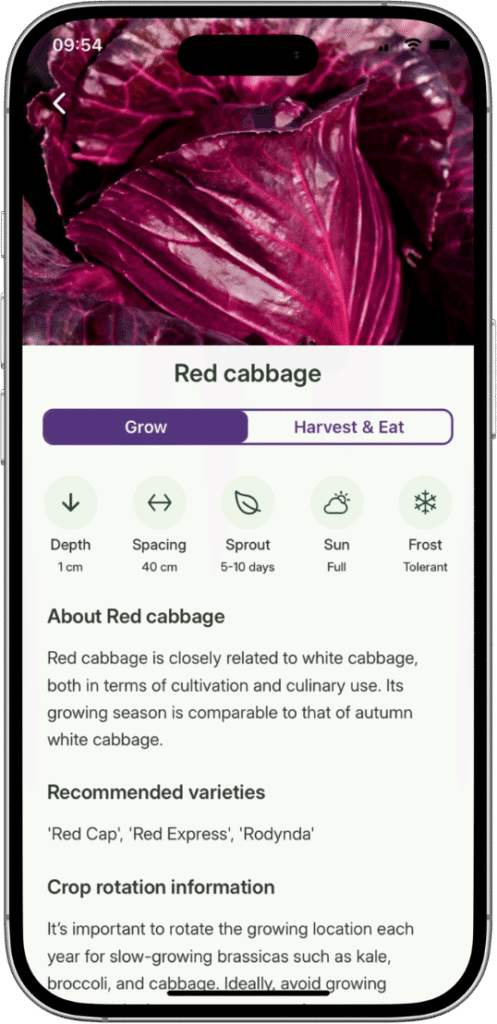
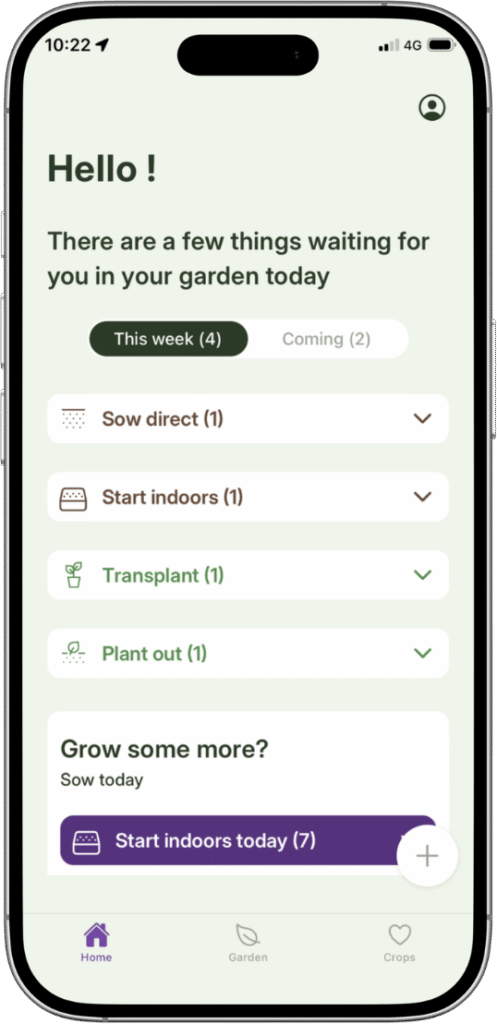
Grow To Eat meters nothing. Your sowing plan, the weekly view and all 120+ crop guides are open on the free tier and stay open, however many crops you look up and however often you change your mind in February.
Whether that matters depends on how you plan. If you settle your year in one sitting, 10 credits may be plenty. If you keep adjusting as the season goes on, a monthly allowance is a strange thing to have to think about while gardening.
A garden app, or a gardening platform
Seedtime is building a platform: alongside the calendar there is inventory tracking, a weather dashboard, records and analytics, multiple calendars, a classroom, a community and a seed store. For a market gardener or someone running several plots, that breadth is the point.
Grow To Eat is a garden app and intends to stay one. 120+ edible crops, dates from your location, a weekly view of what needs doing, and a planner for your beds. No inventory, no analytics, no store, no journal — that last one left out deliberately, because photographing your garden is not the same as growing more from it.
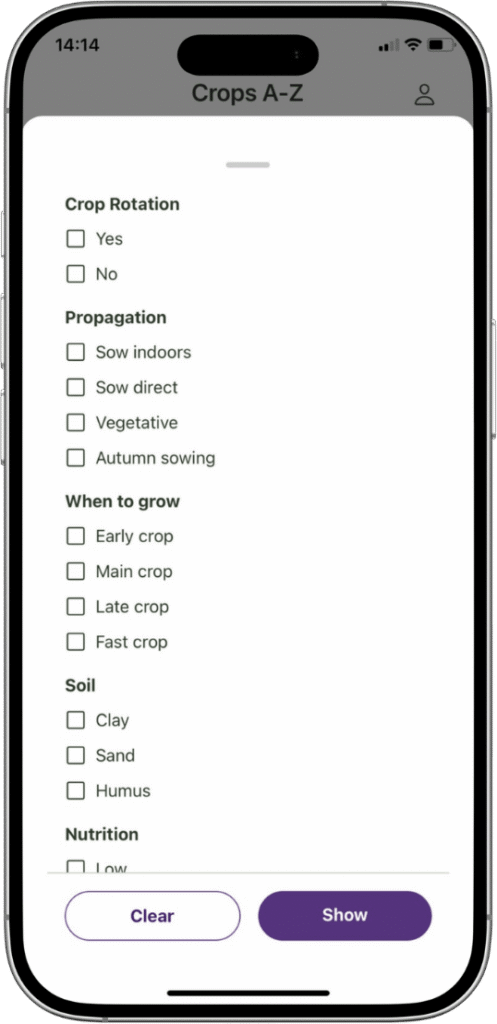
The same thinking runs through the crop library. Grow To Eat works at the level of crops rather than shipping thousands of named varieties, and lets you add the varieties you actually sow on Premium. Most people grow a handful they already trust; a list of 2,650 mostly adds scrolling between you and a decision.
More features is not the same as more harvest. Which of those you are buying is worth deciding before you subscribe to either.
Know what to do in the garden this week
Free to start on iPhone and Android. Upgrade any time.
Choose Seedtime if…
- You want a garden journal with photos linked to your plantings
- You plan by named variety and want thousands to choose from
- You garden through winter with row covers and want harvest estimates
- You garden in the southern hemisphere
- You want to plan on a desktop as well as a phone
Choose Grow To Eat if…
- You want the lower annual price for the planning you actually use
- You don't want a monthly credit allowance on your sowing dates
- You are growing food and don't need inventory, analytics or a store
- You want unlimited beds in your garden without paying for a top tier
- You want a smaller app with less to set up before you start sowing
Grow To Eat vs Seedtime: the bottom line
Grow To Eat is the narrower and cheaper of the two, and deliberately so: €44.99 a year against $84 for Seedtime Basic, nothing metered, unlimited beds, a free tier that never expires, and 120+ edible crops rather than a library you have to search.
Where Seedtime goes further is breadth — 9,705+ varieties, a photo journal, harvest records with analytics, winter-gardening estimates, inventory and a web version. If you want a platform to run your growing on rather than an app to grow with, that is worth paying for.
Both will tell you when to sow. The question is whether you want the rest of it — and whether you want to pay about twice as much for the parts you do.
Frequently asked questions
Which is better, Grow To Eat or Seedtime?
Which is cheaper, Grow To Eat or Seedtime?
What do you get on each free tier?
What are Seedtime credits?
Which has more plants?
Which one works where I garden?
Does Grow To Eat have a garden journal?
Is Seedtime free?
What are the best Seedtime alternatives?
Everything you need to grow more food, for €44.99 a year.
Free sowing plans and growing guides. No credit card required.
Head-to-head comparisons
Last updated: August 2026