
Grow To Eat vs GrowVeg: which garden planner is right for you?
Grow To Eat is a tool that helps you each day in the garden: a native iOS and Android app, focused only on edible crops, that tells you what needs doing this week. GrowVeg is a garden layout planner — many crops and varieties, crop rotation warnings, companion planting — with no native mobile app to carry the plan out to the beds.
Grow To Eat is built for the actual growing season. Sowing dates from your own location, a weekly view of what to sow, tend and pick, harvest tracking, and 120+ edible crops with a full growing guide behind each one — on the phone that is already in your hand when you are standing at the bed.
The planning side of GrowVeg on the other hand is powerful. Many crops and varieties, crop rotation and spacing warnings, and companion planting built from hundreds of scientific studies. All of it lives in a web browser, and it stays there — there is no iPhone or Android app, so to reach your plan or your notes out at the beds you are logging in to a website on your phone.
At a glance
What they share
- ✓Visual drag-and-drop garden bed planner
- ✓Planting dates personalised to where you garden
- ✓Succession planting to keep beds producing
- ✓Companion planting guidance
- ✓Add your own crops and varieties (Premium in Grow To Eat)
- ✓Step-by-step growing guidance for each crop
Where Grow To Eat differs
- ●A native app on both iOS and Android, not a browser tool
- ●Built only for edible crops — no ornamentals to wade through
- ●A weekly “what to do now” view: sowings, next steps and harvests together
- ●A free tier that never expires, rather than a 7-day trial
- ●Crop suggestions filtered by shade, pollinator value and difficulty
- ●Designed to be used standing in the garden, on a phone
Grow To Eat vs GrowVeg: feature comparison
| Feature | GrowVeg | Grow To Eat |
|---|---|---|
| Once the season starts | ||
| Weekly “what to do now” view | Partial | ✓ |
| Task list for what's due | Journal, in a browser | In the app |
| Harvest tracking | Journal, in a browser | In the app |
| Reminders for what's next | You set them, plus a 2-weekly email | Worked out from your sowing dates |
| Succession planting for continuous harvest | ✓ | ✓ |
| Crop rotation warnings | ✓ | – |
| Plant spacing warnings | ✓ | – |
| What you can grow | ||
| Focus | Whole garden | Edible crops only |
| Plant types in the library | 408 incl. flowers & ornamentals | 120+ edible crops, incl. edible flowers and berries |
| Named varieties built in | 21,657 | No — by design, you add your own |
| Crop filters (shade, pollinators, difficulty) | – | ✓ |
| A–Z guides: propagation to preservation | Partial | ✓ |
| Where and how you use it | ||
| Personalised planting dates | Yes — 5,000 weather stations | Yes — your location |
| Where it works | Global, both hemispheres | Northern hemisphere |
| How you use it | In a web browser | Native iPhone and Android apps |
| What it costs | ||
| What's behind the paywall | Everything — there is no free tier | Garden planner, succession planting, custom crops |
| Free tier | None — 7-day trial | Uncapped sowing plan + all guides |
| Yearly price | $35 recurring / $50 one year | €44.99 |
Prices and features checked August 2026. GrowVeg pricing shown in USD, Grow To Eat in EUR. Prices shown in the currency each app charges in.
A garden planner that lives in your pocket
Free sowing plans and full A–Z growing guides. No credit card required.
The key differences explained
A tool for each day, or a plan drawn once
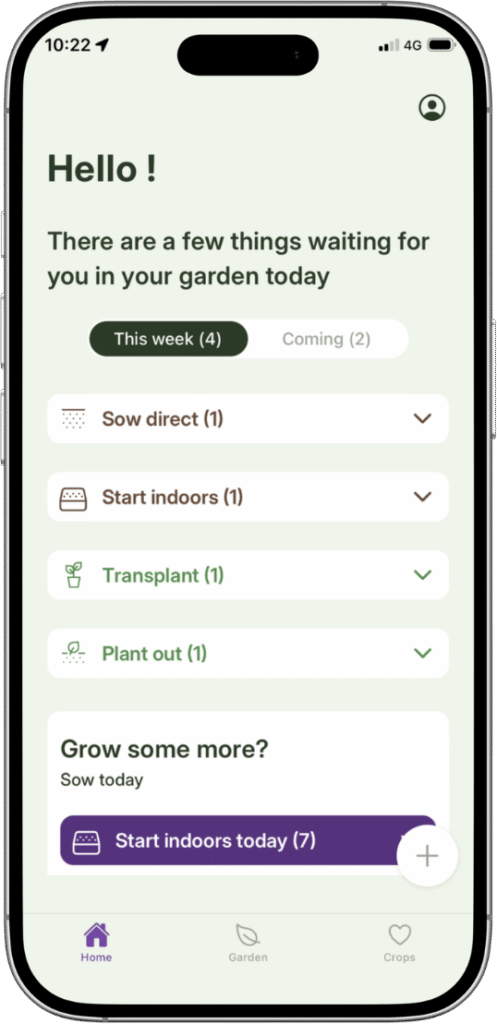
Grow To Eat is a native app on both iPhone and Android, and it is built for the ten months after the plan exists: open it standing at the bed with muddy hands and it shows this week’s sowings, the next step for everything already in the ground, and what is ready to pick.
GrowVeg is delivered in a web browser, and their own guidance for using it outdoors is to work “from your mobile or tablet device” — a browser on a phone, not an app from the App Store or Google Play. The planner is designed for a large screen and a mouse, and it is excellent for an evening of planning in January.
There is help during the season too: an email every two weeks telling you what to sow next, and a Garden Journal where you can log what you planted, watered and harvested and set your own reminders. It is a record you keep and reminders you remember to set, reached by logging in to a website. Grow To Eat works the other way round — the next step for every crop is worked out from the date you sowed it, and this week’s version of that list is the first thing you see when you open the app.
Planning a garden and running one are different jobs, and they suit different devices. This is the difference that matters most day to day.
A whole garden, or the edible part of it
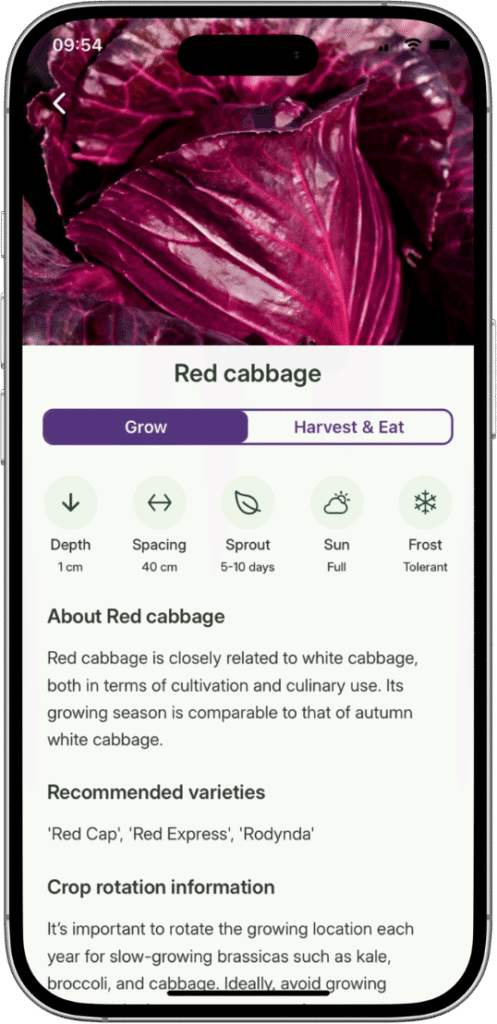
The library gap is real and worth stating: 408 vegetables, herbs, fruit and flowers in GrowVeg, with 21,657 named varieties, plus ornamentals, trees, shrubs and tropical plants. If you want to design a whole garden — borders, hedging and the vegetable patch together — that breadth is the reason to choose it.
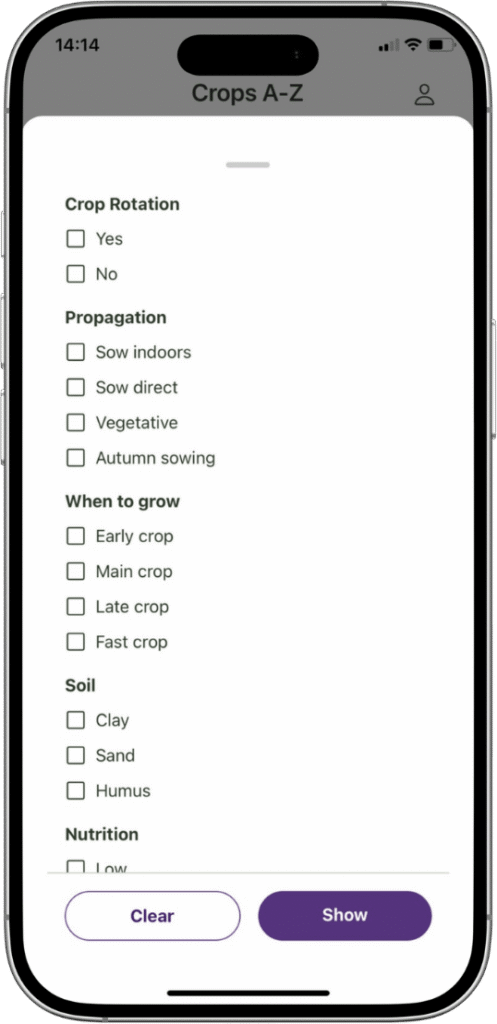
Grow To Eat carries 120+ crops and every one of them is food. Nothing ornamental, nothing you cannot eat. That makes the library smaller and the choosing faster, and it is why the crop filters ask the questions a food grower actually asks: what will crop in partial shade, what feeds pollinators, what is forgiving in a first season.
Bigger is better if what you want to do is design your whole garden. Narrower is better if what you want is to plan and get support while you grow food — in your garden, on your allotment or in your kitchen garden.
What you get without paying
Grow To Eat’s free tier does not expire. Your sowing plan, the weekly view and the full A–Z growing guides stay open for as long as you want them, with no cap. Premium adds the visual garden planner — drag-and-drop beds, the bed-by-bed overview and succession planting — at €7.49/month or €44.99/year.
With GrowVeg you get 7 days free, no card required, and then the planner closes unless you subscribe: $35 a year on the recurring plan, $50 for a single year, or $85 for two. There is no permanent free tier.
Worth being straight about the money: Grow To Eat is the more expensive of the two if you pay for a year, €44.99 against $35. What the €44.99 buys that the $35 does not is the part that runs all season, on your phone, plus a free tier that never closes.
Know what to do in the garden this week
Free to start on iPhone and Android. Upgrade any time.
Choose GrowVeg if…
- You want to design a whole garden, not just the edible part
- You want crop rotation and spacing warnings doing the thinking for you
- You want a specific named variety from a very large library
- You plan at a computer, like room to work, and don't need to reach your plan easily when you're out in the garden
- You garden in the southern hemisphere
Choose Grow To Eat if…
- You want a real app on your phone, iPhone or Android, out in the garden
- You are growing food and don't need ornamentals in the way
- You want to open an app and see what to do this week
- You want to keep using it for free rather than subscribe to start
- You want to get growing without learning a design tool first
Grow To Eat vs GrowVeg: the bottom line
Grow To Eat is the one you will open every day. A native app on iPhone and Android, edible crops only, sowing dates from your own location, and a weekly view that tells you what to sow, tend and pick — used standing in the garden rather than sitting at a desk. It stays free for as long as you want it to.
For drawing the layout, GrowVeg gives you more to work with: more plants, more varieties, crop rotation and spacing warnings, structures in the plan and both hemispheres covered, for $35 a year. It is a powerful planning tool. What it does not have is a mobile app to help you with the tasks that follow — the plan is made in a webapp.
So the question is which half of the job you want help with: drawing the garden once, or growing it every week.
Frequently asked questions
Which is better, Grow To Eat or GrowVeg?
Which app can I use in the garden?
What do you get on each free tier?
Can an app tell me what to do in the garden each week?
Which has more plants?
Which is better for a small vegetable garden?
Does Grow To Eat have crop rotation?
Is GrowVeg free?
What are the best GrowVeg alternatives?
Grow To Eat is built for growing food, on the phone already in your hand.
Free sowing plans and growing guides. No credit card required.
Head-to-head comparisons
Last updated: August 2026