Crop Rotation: How to Plan a Four-Year Rotation for a Healthy Vegetable Garden
- April 30, 2026
- By Editorial Team | Reviewed by:
- Christin Hanssen
Quick answer: Crop rotation means moving each vegetable family to a different bed every year so the same crop doesn’t grow in the same spot more often than once every four years. The goal is to break the life cycle of soil-borne diseases and pests that target specific plant families. Rotation matters most for brassicas, potatoes, onions, root vegetables, and peas and beans — fast-growing salad crops can be ignored.
This guide shows you exactly how to group your vegetables, plan a simple four-year rotation, and avoid the most common mistakes.
What is crop rotation?
Crop rotation is the practice of moving each vegetable family to a different bed each year, instead of growing the same crop in the same spot season after season. After three or four years, you return the crop to its original bed.
The reason it works is simple: many of the most damaging garden problems — club root in brassicas, scab in potatoes, white rot in onions, carrot fly larvae — live in the soil and target a specific plant family. If you grow that family in the same spot every year, the problem builds up. If you move the family to a different bed, the disease or pest in the original soil has nothing to feed on and dies back.
A second benefit is nutrient balance. Different plant families take different nutrients out of the soil and put different ones back in. Rotating crops keeps the soil balanced without heavy fertilising.
Which vegetables need to be rotated?
The crops that benefit most from rotation are the ones with long growing seasons and known soil-borne enemies:
- Brassicas — cabbage, kale, broccoli, cauliflower, kohlrabi, Brussels sprouts, turnips
- Potatoes
- Onions, leeks, garlic, and shallots
- Carrots, parsnips, and parsley (same family)
- Peas, beans, and broad beans
The crops you don’t need to rotate are the fast-growing ones: lettuce, spinach, arugula, herbs, and other salads. They’re in the soil for too short a time to cause problems and can fill any bed where space opens up.
How do I plan a four-year crop rotation?
The simplest method is to divide your growing area into four beds and group your crops into four families. Each year, every group moves one bed clockwise. After four years, every group has visited every bed and you start again.
A typical home-garden rotation looks like this:
Group 1 — Legumes (peas and beans). Fix nitrogen from the air into the soil through their roots. Leave the soil enriched for the next group.
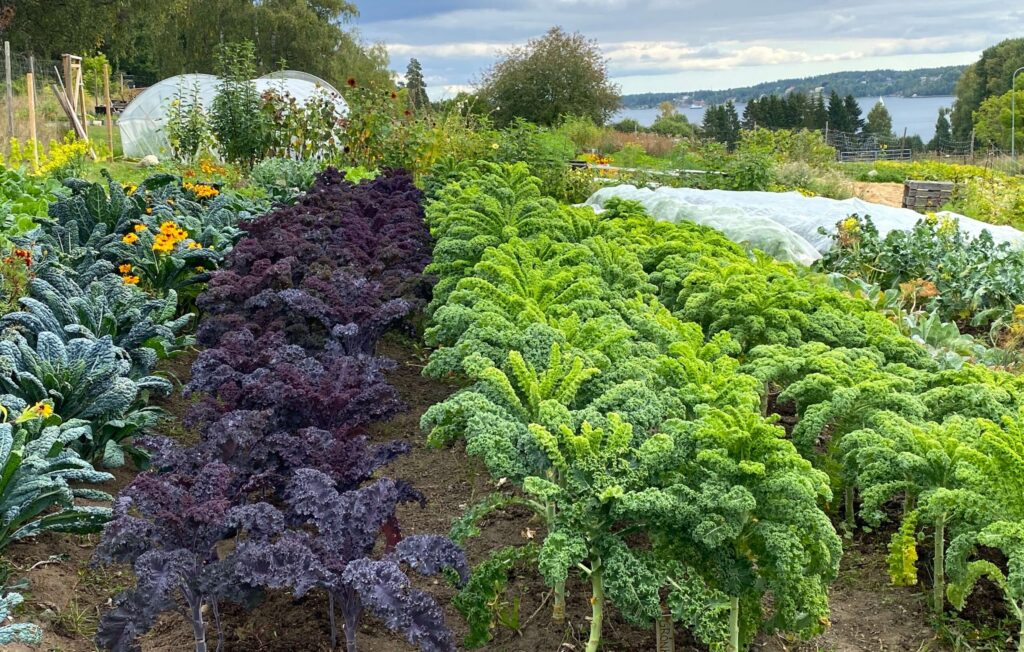
Group 2 — Brassicas, leafy greens, leek and celery. Heavy feeders that benefit from the nitrogen the legumes left behind. Cabbage, kale, broccoli, cauliflower, kohlrabi, chard, leek, celery. Many of plants can also be left in the bed in autumn as they can tolerate low temperatures.
Group 3 — Root vegetables. Carrots, parsnips, beetroot, onions, garlic. Lighter feeders that don’t want rich soil — too much nitrogen makes carrots fork.
Group 4 — Fruiting and tuber crops. Squash, courgettes, cucumbers, sweetcorn. Heavy feeders again — give this bed the most compost before planting.
We usually grow fruiting crops like tomatoes, peppers and aubergines in containers.
Your exact groupings will depend on which crops you actually grow. If you grow potatoes, add them in Group 4 with other heavy feeders. If you grow a lot of brassicas, you might split Group 2 across two beds.
When grouping, balance three things: the plant family (most important — most diseases attack the whole family), the nutrient demand (heavy versus light feeders), and the water demand. Crops with similar needs grow well together and are easier to look after as a group.
What if I only have one or two beds?
Strict four-year rotation isn’t possible in a small garden, but you can still get most of the benefit with a relaxed version:
- Two beds: alternate heavy feeders (brassicas, squash, potatoes) with light feeders (root vegetables, legumes) year by year. Add compost generously to keep the soil topped up.
- One bed or containers: focus on soil renewal instead. Replace the top 5–10 cm of soil or compost each year, and avoid growing the same family two years in a row even within a single bed.
- Raised beds: treat each raised bed as a separate area in the rotation. Even a 1×2 m raised bed counts as one rotation slot.
The core rule still applies: don’t follow brassicas with brassicas, or potatoes with tomatoes (same family).
What are the most common crop rotation mistakes?
A few mistakes catch out most home gardeners:
- Forgetting that tomatoes and potatoes are the same family. They both belong to the nightshade family (Solanaceae) and share diseases like blight. Don’t rotate one to where the other was.
- Rotating only the obvious crops. Onions and garlic share white rot; rotate them as a group, not just “alliums I happen to remember.”
- Ignoring perennials. Rhubarb, asparagus, and perennial herbs stay where they are — that’s fine, just plan your rotation around them.
- Skipping rotation because “the soil looks healthy.” Soil-borne disease build-up is invisible until it isn’t. By the time you see club root or white rot, you’ve got a multi-year problem.
Frequently asked questions
What is crop rotation in simple terms? Crop rotation means growing the same crop in a different bed each year, so the same vegetable doesn’t grow in the same spot more often than once every three or four years.
Why is four years the standard rotation length? Most soil-borne diseases and pests die back within three to four years if their target plant isn’t there to feed on. Some, like club root, can survive longer — up to seven years, or more — but four years is the practical sweet spot for most home gardens.
Which vegetables don’t need to be rotated? Fast-growing salad crops — lettuce, spinach, arugula, mizuna, and most herbs — don’t need rotation. They’re in the soil too briefly to cause disease build-up and can fill gaps in any bed.
Can I grow the same plant family in the same bed two years running? Not recommended. This is exactly when soil-borne disease builds up fastest. If you have to, change as much of the soil as you can between plantings and add compost.
What’s the difference between crop rotation and succession planting? Crop rotation happens across years — moving the same crop to a different bed each year. Succession planting happens within one year — filling the same bed with a series of fast-maturing crops in a single season. They work together. Read more in our succession planting guide.
Do I need to rotate crops in raised beds and containers? Yes, but the rules are simpler. Treat each raised bed as one rotation slot. For containers, the easiest fix is to refresh the top 5–10 cm of compost each year and avoid repeating the same plant family two years running.
Where do herbs fit in a crop rotation? Most perennial herbs (rosemary, thyme, sage, oregano, chives) stay in one place permanently — plan your rotation around them. Annual herbs like basil, dill, and coriander are short enough that they don’t need rotation and can be slotted into any bed.
Want some help?
Every crop in the Grow To Eat app shows its plant family — Brassicaceae, Solanaceae, Apiaceae, and so on — so you can filter the plants and see at a glance which crops belong together for rotation purposes.
Download free today